


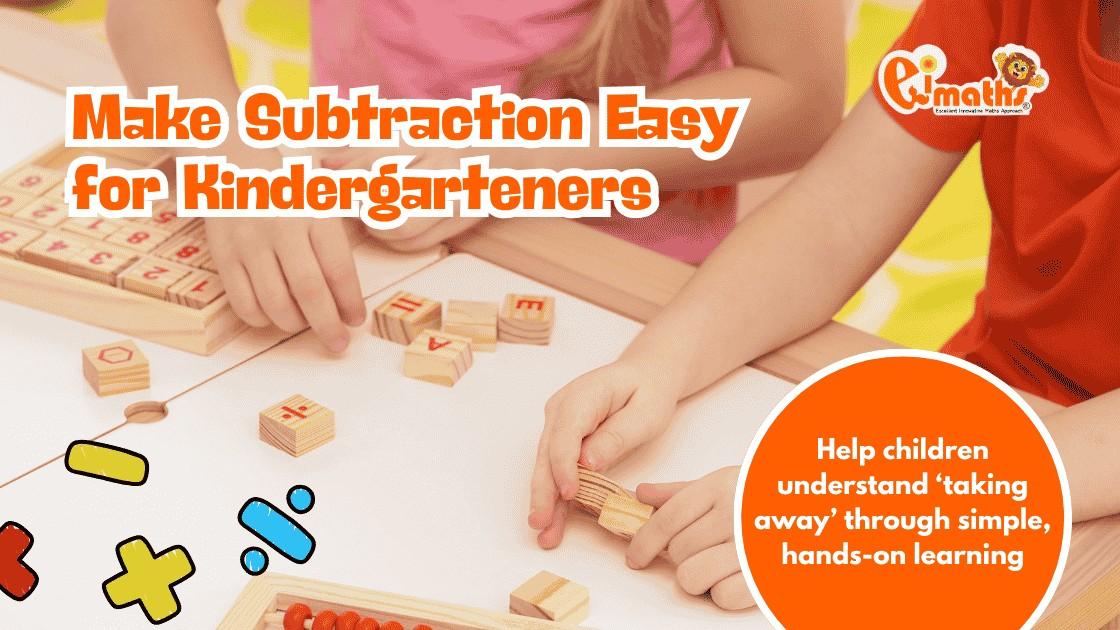
Teaching subtraction in kindergarten is often one of the first major milestones in a child’s math journey. While counting focuses on adding more objects to a group, subtraction introduces a new concept: taking something away and understanding what remains.
For many young learners, subtraction can initially feel abstract. A child may be able to count to twenty confidently but still struggle to understand why five objects become three after two are removed. This is completely normal. Kindergarteners learn best when mathematical concepts are connected to real experiences they can see, touch, and explore.
The goal is not simply to teach children how to calculate answers. Instead, it is to help them understand what subtraction means and how it applies to everyday situations. When children develop this understanding early, they build a strong foundation for future learning.
Why Subtraction Can Be Challenging for Young Learners
Subtraction requires children to think differently about numbers. Rather than increasing quantities, they must understand how quantities decrease.
Young children often learn through concrete experiences. They need opportunities to physically observe objects being removed from a group before they can understand subtraction symbols and equations.
For example, if a child has six toy cars and two are taken away, seeing only four cars remaining helps them connect the action to the mathematical concept.
Before introducing worksheets or formal equations, it is helpful to focus on hands-on experiences that make subtraction visible and meaningful.
An Easy Way to Think About Subtraction
This simple progression reflects how most children naturally develop subtraction understanding. They move from physical experiences toward mathematical symbols step by step.
1. Use Real Objects Every Day
The most effective subtraction lessons often happen outside formal learning environments.
Parents can create opportunities throughout the day by using objects children already interact with.
Examples include:
- Snacks during mealtime
- Building blocks
- Toy animals
- Crayons
- Stickers
A parent might say:
“You have seven grapes. If you eat two grapes, how many are left?”
Children can physically remove the grapes and count what remains.
These experiences make subtraction meaningful because children can see the result immediately.
2. Turn Subtraction Into Stories
Stories help children understand mathematical concepts within familiar situations.
For example:
“Five ducks were swimming in a pond. Two ducks swam away. How many ducks are still in the pond?”
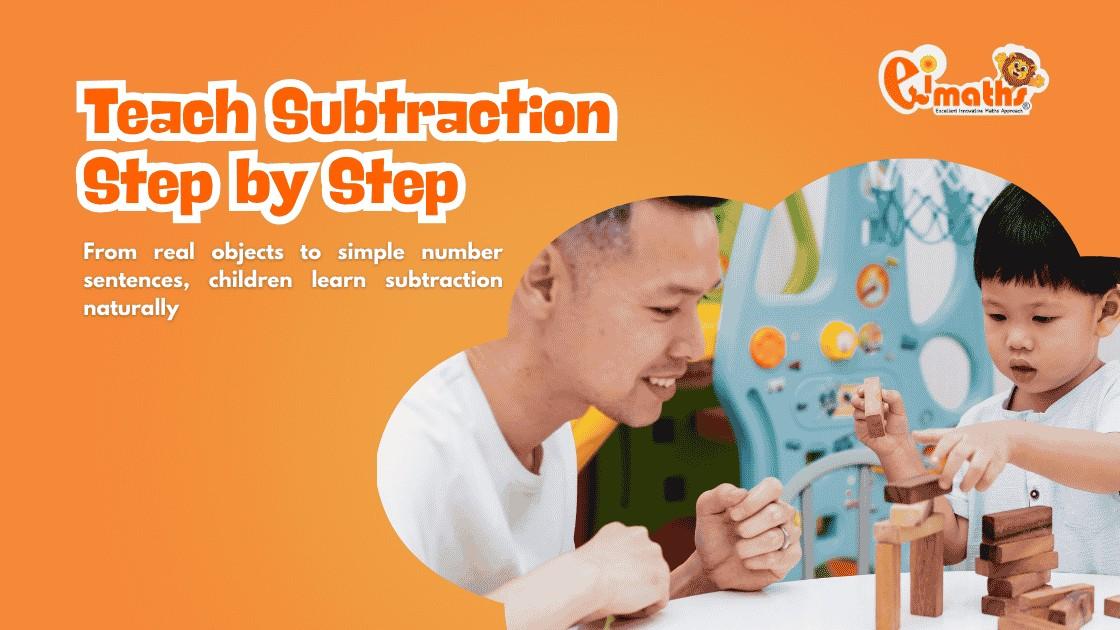
Children can use toy figures, drawings, or counters to act out the story.
Story-based learning encourages imagination while reinforcing mathematical thinking.
It also helps children connect numbers to real-world situations rather than viewing math as a collection of isolated facts.
3. Encourage Children to Act It Out
Movement-based learning is particularly effective for kindergarteners.
Children can physically represent subtraction problems using their bodies.
For example:
Ten children stand in a line.
Three children step away.
The remaining children count how many are still standing.
Activities like these help children experience subtraction through movement, which often improves understanding and memory.
4. Use Visual Models Before Equations
Many children struggle when subtraction is introduced as symbols too early.
Visual models help bridge the gap between concrete experiences and abstract thinking.
Parents and educators can use:
- Counters
- Number frames
- Drawings
- Picture cards
- Number lines
These visual supports allow children to see what is happening when a quantity decreases.
As understanding grows, children become more comfortable with subtraction equations.
5. Focus on Understanding Rather Than Speed
One common misconception is that children should answer subtraction questions quickly.
At the kindergarten stage, speed is far less important than understanding.
Instead of asking for immediate answers, encourage children to explain their thinking.
Questions such as:
- What happened to the group?
- How many were taken away?
- How do you know your answer is correct?
help children develop reasoning skills alongside mathematical understanding.
This approach builds confidence and reduces anxiety around math.
6. Introduce Number Sentences Gradually
Once children understand subtraction through objects and pictures, they can begin connecting those experiences to equations.
For example:
Six blocks.
Take away one block.
Five blocks remain.
This can later become:
6 – 1 = 5
Because children already understand the situation, the equation becomes much easier to interpret.
Gradual progression helps children view equations as representations of real experiences rather than abstract symbols.
7. Celebrate Mistakes as Part of Learning
Young learners often worry about getting the wrong answer.
However, mistakes provide valuable opportunities for learning.
If a child makes an error, encourage them to revisit the problem and explore different ways of thinking about it.
This helps children develop resilience, curiosity, and confidence.
When children feel safe making mistakes, they are more willing to engage with challenging concepts and try new strategies.
How to Teach Subtraction for Beginners Successfully
Many parents wonder how to teach subtraction for beginners without making the process overwhelming.
The key is to introduce subtraction gradually.
Children typically learn best when they move through these stages:
- Real objects
- Pictures and visual models
- Story problems
- Number sentences
- Mental reasoning
Each stage strengthens understanding and prepares children for the next level.
Rushing directly into equations can create confusion, while a gradual approach helps children build confidence.
What Are Some Tricks for Easier Subtraction?
Parents frequently ask, what are some tricks for easier subtraction when supporting young learners at home.
For kindergarteners, the most effective strategies focus on understanding rather than shortcuts.
Helpful techniques include:
- Using fingers to represent quantities
- Drawing pictures
- Acting out subtraction stories
- Using number lines
- Working with physical objects
These methods make subtraction visible and concrete, which is exactly what young children need during the early stages of learning.
As children gain confidence, they naturally begin recognising patterns and solving problems more independently.
Conclusion: Building Strong Foundations Through Meaningful Learning
Subtraction is one of the first mathematical concepts that helps children understand how quantities change. When introduced through hands-on experiences, storytelling, visual models, and everyday situations, subtraction becomes far more meaningful and enjoyable.
The goal is not simply to teach children how to find answers. It is to help them understand why those answers make sense. This deeper understanding supports future learning and helps children develop confidence in their mathematical abilities.
At eiMaths, we believe that children learn best when mathematical concepts are introduced through engaging, age-appropriate experiences that encourage exploration and discovery. Our programmes help young learners build strong foundational skills while developing the confidence and curiosity needed to succeed in mathematics and beyond.
With patience, encouragement, and the right learning experiences, every child can develop a positive relationship with math and approach subtraction with confidence.