

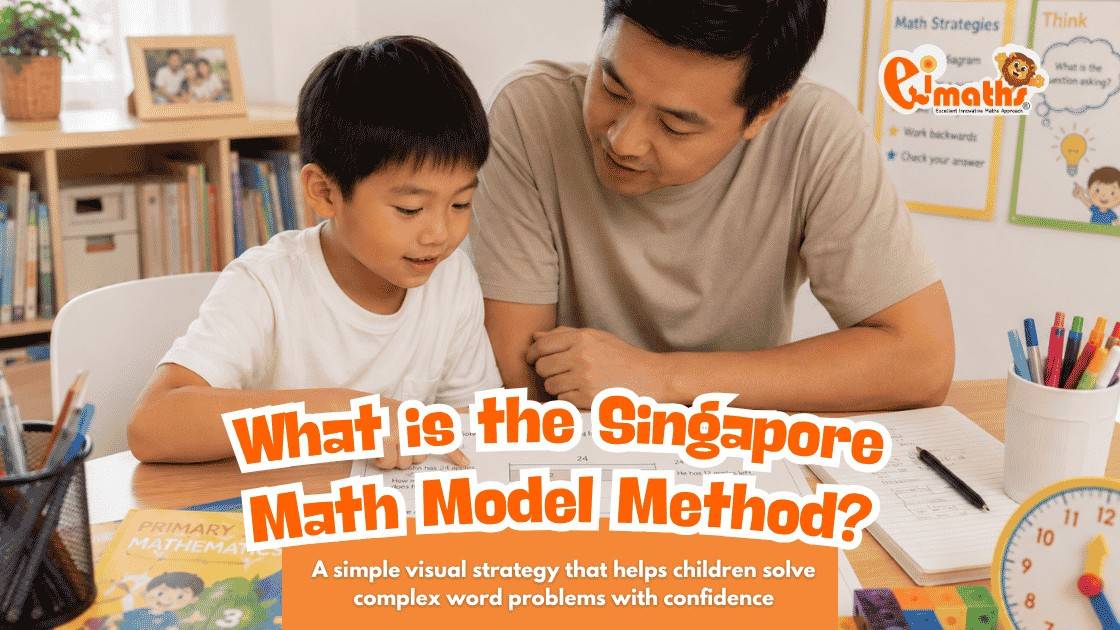
If you have ever sat down to help your primary school child with their homework, you have likely encountered long, rectangular blocks drawn all over their worksheets. Welcome to the world of the singapore math model method.
Introduced by the Ministry of Education (MOE) in the 1980s, this visual approach has gained global recognition for transforming abstract algebraic concepts into simple, visual diagrams. However, for parents who grew up learning math through traditional equations and formulas, trying to understand these drawings can be incredibly confusing.
Let us demystify the bar model method, look at why it is so effective, and explain exactly how it works.
Why Do Schools Use the Model Method?
Young children think in highly concrete terms. They understand physical objects like five apples or three toys. However, when they are suddenly forced to solve abstract algebraic equations like $x + y = 50$, their brains experience a cognitive block.
The singapore math model method acts as a crucial bridge between concrete objects and abstract numbers. It allows students to visually “see” the math problem. By drawing rectangular bars to represent numbers, children can organize information visually, identify the relationships between values, and determine the correct operation without relying on guesswork.
💡 Quick Parent Tip: Think of bar models as a replacement for algebra. Instead of solving for “$x$” or “$y$”, your child is solving for a physical “unit” block on their paper!
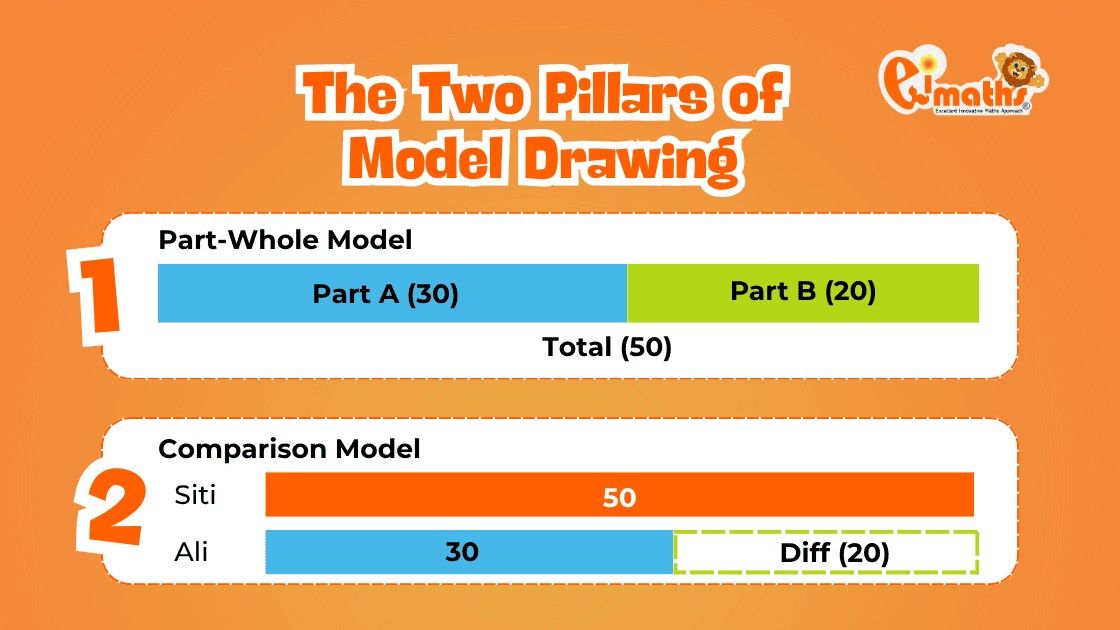
The Two Main Types of Bar Models
To help your child at home, you need to understand the two fundamental building blocks of the model method:
1. The Part-Whole Model
This model is used when a question gives you individual parts and asks for the total, or gives you the total and asks for a missing part. It teaches children that a large quantity is made up of smaller components.
2. The Comparison Model
This model is used when a question compares two or more quantities using phrases like “more than,” “fewer than,” or “twice as many.” It involves drawing two separate bars stacked vertically so the child can visually see the exact difference between them.
🔢 Word Problem Workout: Step-by-Step
Let us look at a typical Primary 3 problem sum to see how the model method simplifies everything:
“Siti and Gopal have 90 stickers altogether. Siti has 20 more stickers than Gopal. How many stickers does Gopal have?”
Instead of using confusing algebra, a student trained in the singapore math model method will layout the problem using this exact workflow:
| Step | Action Taken | Mathematical Equation |
| Step 1 | Draw a shorter bar for Gopal and a longer bar for Siti. | Visual Layout Setup |
| Step 2 | Mark the extra extension on Siti’s bar as “20”. | Isolating the Difference |
| Step 3 | Subtract the extra 20 stickers from the total 90. | $90 – 20 = 70 \text{ stickers}$ |
| Step 4 | Divide the remaining total by 2 equal bars. | $70 \div 2 = 35 \text{ stickers}$ |
| Step 5 | Final Answer: Gopal has 35 stickers. | Completed! |
The visual layout makes the logical steps obvious, preventing children from blindly guessing whether to add or multiply the numbers.
Beyond Drawing: Building True Conceptual Mastery
While drawing models is an excellent tool, it is only effective if a child knows when and how to apply it to complex questions.
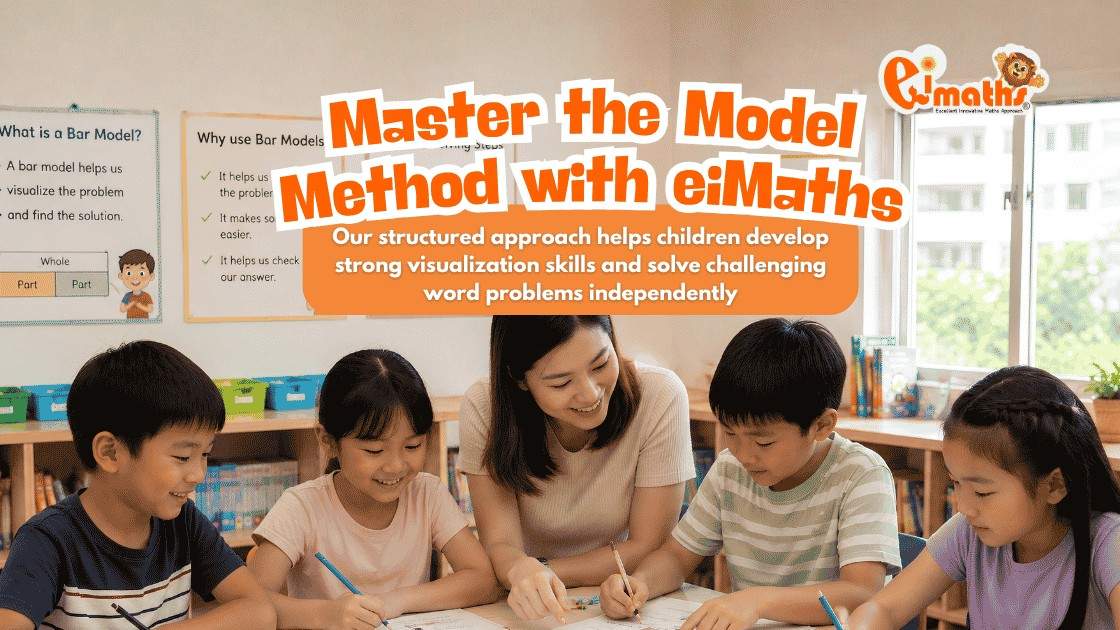
At eiMaths, we specialize in teaching the singapore math model method through a structured, progressive approach. Our unique learning program starts by using actual physical objects in our Kindergarten and Primary 1 classes, slowly transitioning students into drawing accurate bar models by Primary 2 and 3. By keeping our class sizes small (5 to 8 students), our instructors ensure your child masters these visualization tools correctly, giving them the confidence to tackle any exam question independently.