


Teaching primary school mathematics at home can often feel like an emotional battlefield. Many parents find themselves deeply frustrated when trying to explain homework to their children. You might understand exactly how to solve the problem yourself, but explaining it in a way that clicks for a seven-year-old child feels completely impossible.
If you want to know how to teach word problems to primary students without causing tears, tantrums, or homework dread, the secret lies in shifting your teaching methods from abstract formulas to constructive, visual frameworks.
Let us look at a highly effective, step-by-step methodology that transforms complex story sums into clear, visual milestones.
The 4-Step Framework for Creative Teaching
When looking at how to teach word problems to primary students, consistency is your greatest asset. By introducing a uniform process for every single question, your child will build a predictable routine that reduces test anxiety.
Step 1: Isolate the Narrative Context First
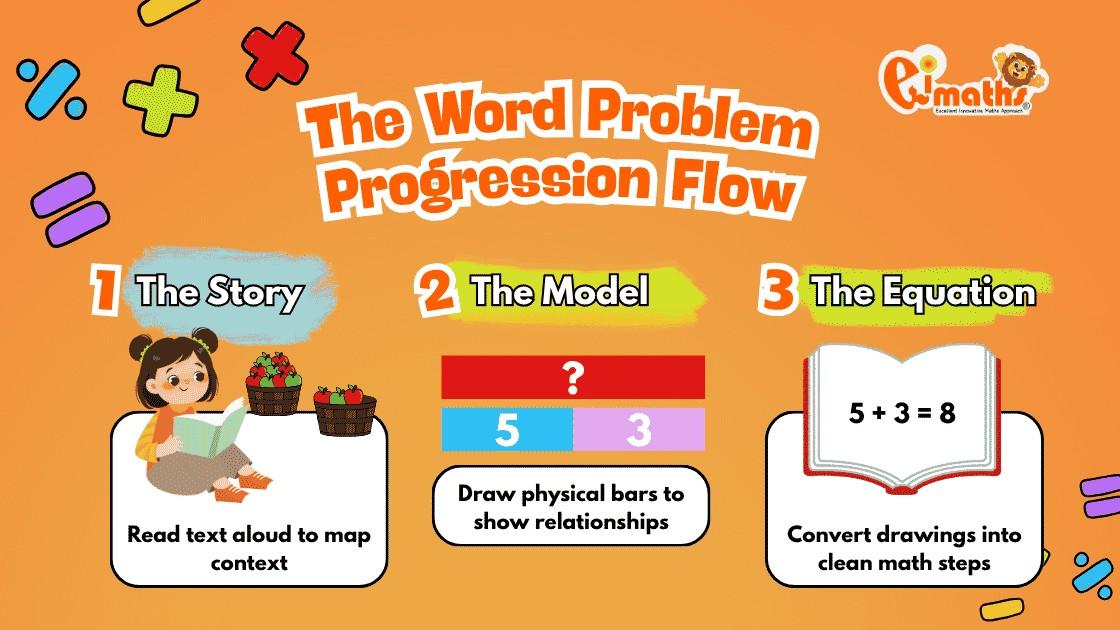
Before your child even touches a pencil or looks at a number, have them read the entire word problem out loud. Ask them to close their eyes and retell the situation to you as if it were a story happening in real life.
For example, if the question is about bakeries and cupcakes, ask: “Who are we talking about? What are they baking? Did they sell things or buy things?” Establishing the real-world scenario ensures their reading comprehension is fully aligned before they worry about numbers.
Step 2: Use Visual Model Drawing
Primary school children think in concrete, visual terms. They struggle to comprehend abstract numbers floating in space. Therefore, teaching them to use visual bar models is an absolute game-changer.
- Draw a long rectangle bar to represent a large total quantity.
- Slice that bar into smaller pieces to show subtraction or division sharing.
- This visual structure instantly shows your child the physical relationship between parts and wholes.
Step 3: Translate the Drawing into a Number Sentence
Once the visual diagram is drawn accurately, the required mathematical operation usually becomes obvious to the child. Guide them to translate their drawing into a clear horizontal number sentence (e.g., $50 – $12 = $38), keeping their workspace highly organized.
Step 4: The Logic Double-Check
The final phase of learning how to teach word problems to primary students is building a reflection habit. Once your child derives a final number, ask them: “Does this answer make sense?” If the question states that a character gave away money, but the final answer shows they have more money than they started with, your child will instantly realize their logical path went off course.
Avoiding the “Spoon-Feeding” Trap
The biggest mistake parents make when teaching math at home is stepping in too quickly to write out the solution when their child gets stuck. While this finishes the homework faster, it robs the child of critical brain development.
| What to Avoid Doing (Spoon-Feeding) | What to Do Instead (Constructive Teaching) |
| Writing down the math equation for them. | Asking: “What diagram can we draw to show this?” |
| Telling them: “Just add these two numbers together.” | Asking: “Does this person have more or less at the end?” |
| Getting angry when they make a mistake. | Saying: “Let’s test this answer out to see if it fits.” |
The eiMaths Approach to Constructive Learning
Mastering how to teach word problems to primary students requires patience, specialized tools, and a deep understanding of childhood psychology.
At eiMaths, we use a fully interactive, constructive learning approach. Our uniquely designed full-color workbooks break down complex mathematical concepts into small, bite-sized learning steps. Combined with our hands-on activity boxes, we guide students to discover mathematical truths independently. We do not just teach children how to pass an exam—we teach them how to think logically for the rest of their lives.