


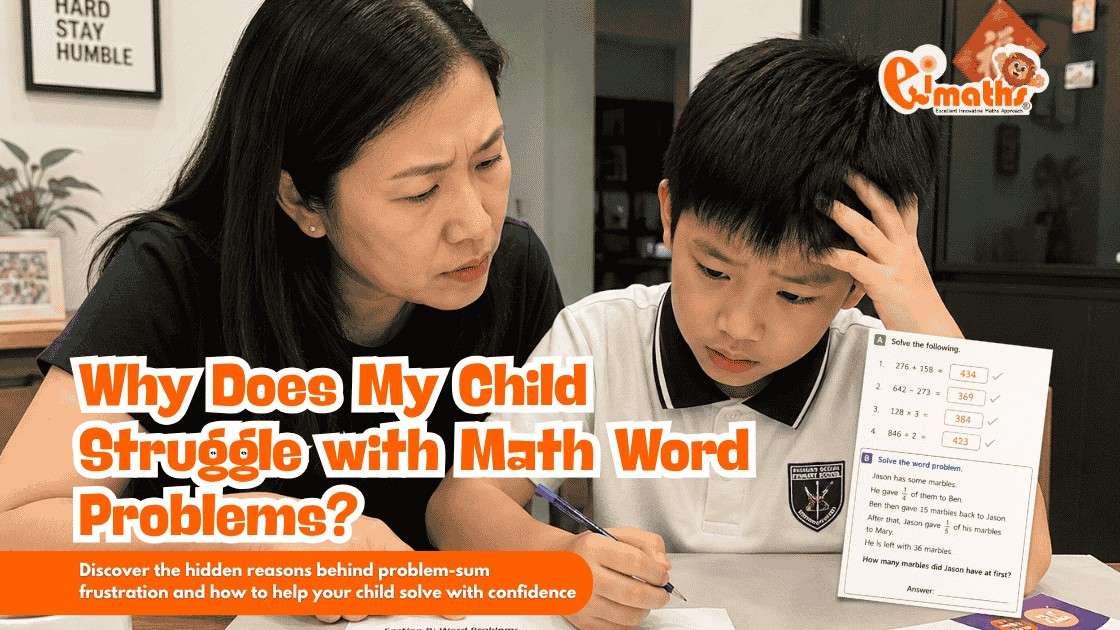
It is a familiar, frustrating scene in many households across Singapore. If your child struggles with math word problems, homework can quickly become stressful. Your child sits down at the kitchen table with their math homework. They easily fly through a worksheet filled with straightforward arithmetic, like 24 + 13 or 15 × 5. But the moment they flip the page and encounter a story-based problem sum, everything grinds to a halt. Tears flow, pencils are dropped, and frustration takes over.
If your child struggles with math word problems, you are definitely not alone. Many primary school students find translating English sentences into mathematical equations to be an incredibly daunting wall.
Understanding why this block happens is the first step toward finding a lasting solution. Let us dive deep into the hidden psychology and mechanics behind why children get stuck on problem sums—and how you can help them navigate it.
The Real Reasons Your Child is Getting Stuck
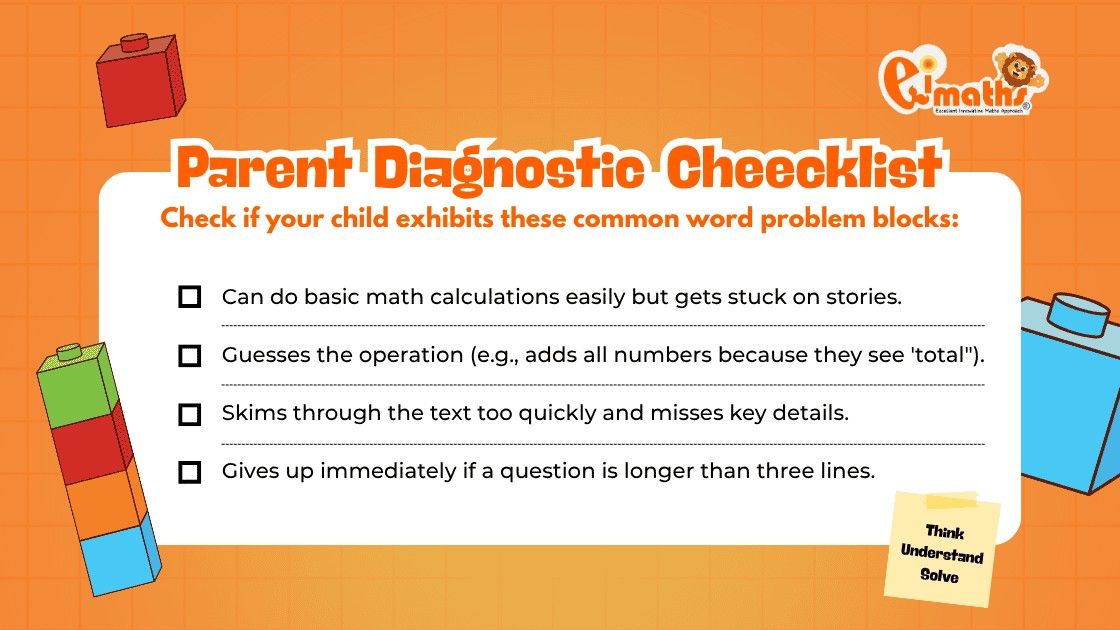
When a child struggles with math word problems, parents often assume the child is simply “bad at math.” However, the truth is usually much more complex. Here are the three major underlying pillars causing this academic roadblock:
1. It is a Language Barrier, Not a Calculation Issue
Math word problems are essentially a foreign language hidden inside an English sentence. Children need to decode specific mathematical keywords that dictate operational functions. For example, words like “remaining,” “difference,” “ratio,” or “shared equally” have exact mathematical meanings. If a student has basic reading comprehension but lacks mathematical literacy, they will fail to map out the question correctly.
2. Cognitive Overload from Multi-Step Complexity
In the lower primary levels, word problems are usually single-step (e.g., “Ali has 5 apples, he buys 3 more. How many does he have?”). However, by Primary 3 and 4, the complexity spikes into multi-step problems.
A single question might require a child to subtract first, find a remainder, calculate a fraction of that remainder, and then add a baseline figure. When a child attempts to process all of this information simultaneously, their working memory experiences cognitive overload, causing them to completely shut down.
3. The Lack of Visual Modeling Skills
Traditional learning often relies heavily on rote memorization and repetitive numerical drills. But complex heuristic word problems cannot be solved by memory alone. They require abstract, critical thinking. Without a reliable, structured method to draw out the problem visually, students are left playing a guessing game with the numbers on the page.
The Solution: A Step-by-Step Parent Blueprint
To fix the issue when a child struggles with math word problems, we must shift away from demanding more repetitive practice papers. Instead, we need to provide them with a structured framework to process information systematically.
| Phase | What the Child Should Do | The Mental Goal |
| 1. Deconstruct | Read the text without looking at the numbers. Retell the story. | Understand the scenario contextually. |
| 2. Isolate | Underline specific math keywords and circle data points. | Separate relevant information from fluff text. |
| 3. Visualize | Sketch a diagram, table, or bar model. | Convert abstract text into concrete shapes. |
| 4. Execute | Write the step-by-step mathematical equations. | Perform accurate arithmetic calculations. |
How to Practice This at Home Today
The next time your child encounters a tricky problem sum, do not give them the answer. Instead, ask them these three guided questions:
- “Can you explain to me what is happening in this story without using any numbers?”
- “What is the question asking us to find out at the very end?”
- “Can we draw a simple box to represent this person’s share?”
By changing how you prompt your child, you train their brain to look at the relationships between values rather than just rushing to calculate a random answer.
Transforming Confusion into Confidence
At eiMaths, we specialize in helping children break through this exact academic barrier. Through our proprietary E.I.G.H.T. Problem-Solving Strategy, we teach students to systematically evaluate, isolate, and solve complex math questions with absolute clarity.
Our small class sizes (5 to 8 students) ensure that our instructors can spot individual comprehension gaps instantly. By pairing our full-color, highly visual workbooks with custom activity boxes, we turn intimidating text into a hands-on, engaging experience. Let us help your child replace homework anxiety with a genuine love for logical discovery.