As children progress from Primary 2 into Primary 3 and 4 in Singapore, parents often notice a massive shift in how math questions are structured. Straightforward calculations disappear, replaced by complex, multi-step problem sums that leave both children and parents scratching their heads. You will frequently hear teachers talk about the importance of heuristics. But what does math heuristics primary school actually mean?
In simple terms, a heuristic is a practical, step-by-step rule or strategy used to solve complex problems when a direct solution path isn’t immediately obvious. It is a toolkit of problem-solving methods that teaches children how to think rather than just what to memorize.
The Most Common Heuristic Strategies Your Child Needs to Know
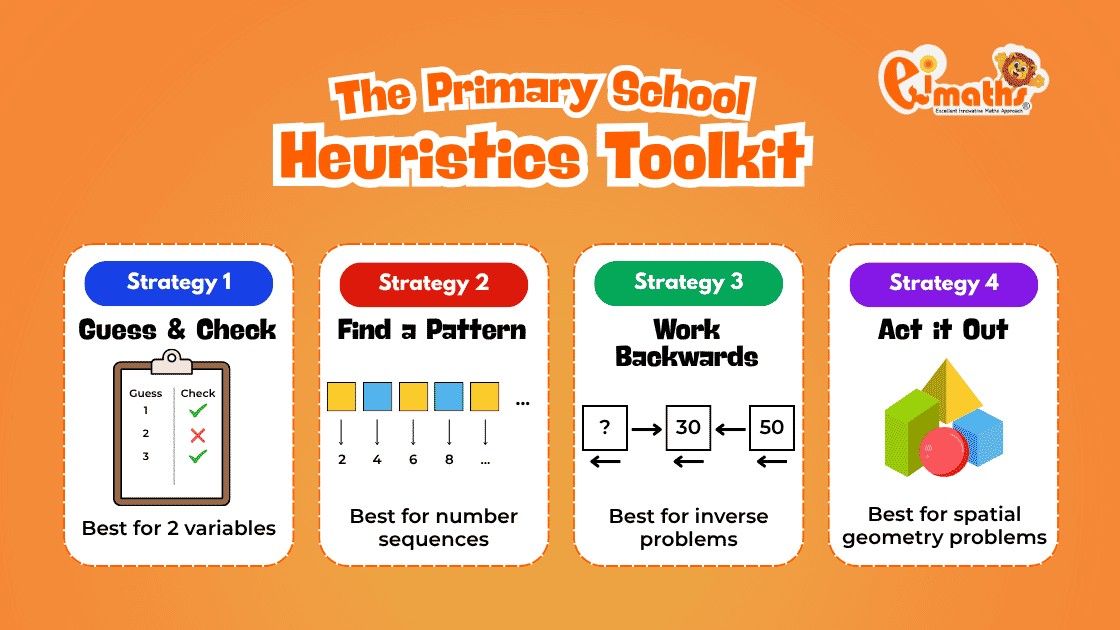
The Ministry of Education (MOE) syllabus outlines several heuristic strategies that primary school students must master. Here are the most prominent ones that appear in primary school exams:
1. Guess and Check (Systematic Listing)
When a problem presents two variables with limited clues (e.g., “There are 20 chickens and goats in a farm, with a total of 64 legs. How many chickens are there?”), students learn to build a structured table to record logical guesses, tweaking variables systematically until they strike the target.
2. Looking for a Pattern
This strategy requires students to analyze a sequence of numbers or shapes, identify the core rule governing the sequence, and predict future terms. This is a foundational pillar of math heuristics primary school that builds strong algebraic thinking.
3. Working Backwards
When a problem sum details a series of transactions or numerical changes but only provides the final outcome, the student must reverse every single mathematical operation step-by-step to discover the original starting number.
🥊 Rote Drilling vs. Heuristic Thinking
Why do children struggle so much with this transition? Let’s analyze the fundamental breakdown:
How to Help Your Child Build Heuristic Skills
Building a strong foundation in heuristics requires patience and early exposure. Rushing a child into high-pressure test papers without teaching them the rules of problem-solving will only lead to math anxiety.
At eiMaths, we help students conquer math heuristics primary school through our proprietary E.I.G.H.T. Problem-Solving Strategy. Our specialized, full-color workbooks break down complex heuristic types into highly manageable, bite-sized concepts. Rather than spoon-feeding answers, our teachers use guided discovery to help children figure out which strategy to apply, turning intimidating exam papers into a series of fun, rewarding puzzles.