


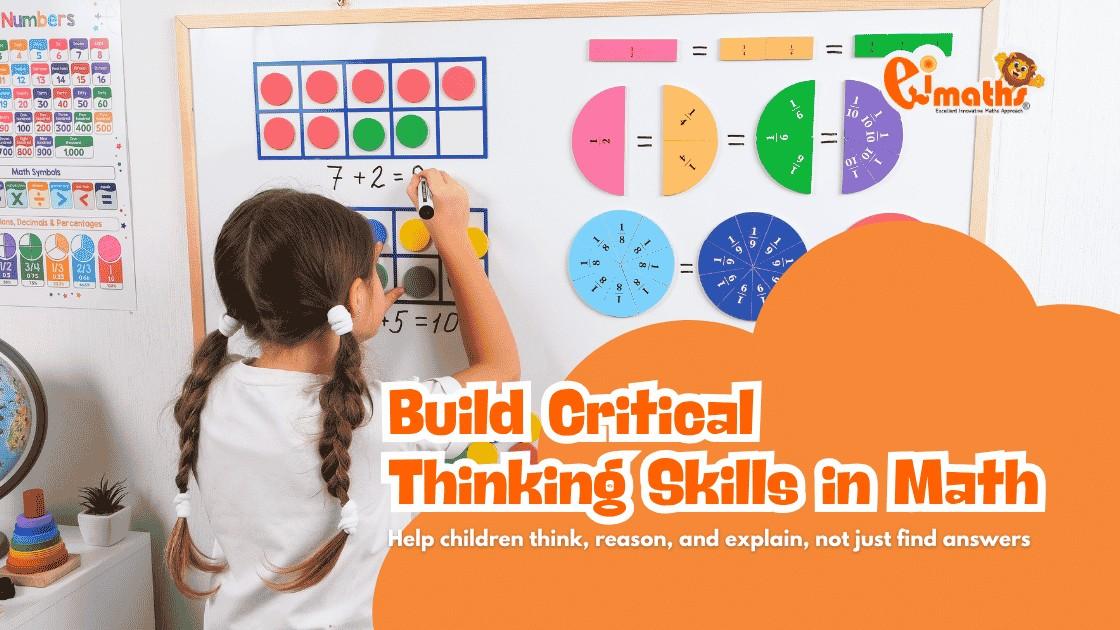
Critical thinking skills in math are among the most valuable abilities children can develop during their early learning years. While many people associate mathematics with numbers and calculations, true mathematical success depends on much more than memorising formulas or finding correct answers. Children need to learn how to analyse information, identify patterns, make connections, and justify their thinking.
Mathematical reasoning allows children to move beyond simply following instructions. It encourages them to understand why a solution works, explore different approaches, and apply their knowledge to new situations. These skills not only support success in mathematics but also help children become stronger thinkers in everyday life.
As children grow, they will encounter increasingly complex problems that require logic, creativity, and decision-making. By developing mathematical reasoning from an early age, parents and educators can help children build the confidence and thinking skills needed for long-term learning success.
Understanding Mathematical Reasoning
Mathematical reasoning refers to the ability to think logically about numbers, patterns, relationships, and mathematical situations. Instead of focusing solely on answers, children learn to explain their thinking and evaluate different possibilities.
Many parents ask, what are critical thinking skills in math? These skills include the ability to:
- Analyse information carefully
- Identify patterns and relationships
- Compare different solutions
- Make predictions
- Draw logical conclusions
- Explain reasoning clearly
When children practise these skills regularly, they begin to see mathematics as a process of thinking rather than a collection of rules to memorise.
Strong reasoning skills also help children become more independent learners. They learn how to approach unfamiliar problems with confidence and persistence.
Why Mathematical Reasoning Matters
Mathematical reasoning plays a central role in helping children understand concepts deeply. When children rely only on memorisation, they may struggle when faced with new types of questions. However, when they understand the reasoning behind mathematical ideas, they are better equipped to adapt and solve unfamiliar problems.
Reasoning skills support:
- Problem-solving abilities
- Decision-making skills
- Number sense development
- Pattern recognition
- Confidence in learning
- Academic achievement across subjects
Children who develop strong reasoning skills often become more willing to take on challenges because they understand that learning involves exploration and thinking rather than simply producing correct answers.
Encouraging Children to Explain Their Thinking
One of the most effective ways to develop reasoning skills is to encourage children to explain how they arrived at an answer.
Rather than asking only, “What is the answer?” adults can ask questions such as:
- How did you figure that out?
- Why do you think that works?
- Can you show another way?
- What pattern do you notice?
- How do you know your answer is correct?
These questions encourage children to reflect on their thinking process and communicate their ideas clearly.
When children verbalise their reasoning, they often strengthen their own understanding while building confidence in their problem-solving abilities.
Using Open-Ended Questions
Open-ended questions are particularly valuable because they allow children to explore multiple solutions rather than searching for a single correct answer.
For example, instead of asking:
“What is 10 minus 3?”
An open-ended question might be:
“How many different ways can you make 7?”
This type of question encourages children to think flexibly and recognise relationships between numbers.
Open-ended tasks also help children understand that mathematics is creative and exploratory. Different approaches can often lead to the same solution.
Developing Reasoning Through Patterns
Patterns provide an excellent introduction to mathematical reasoning because they help children identify relationships and make predictions.
Children can explore patterns through:
- Number sequences
- Shape arrangements
- Colour patterns
- Movement activities
- Everyday objects
When children identify patterns, they begin to understand how mathematical relationships work. They learn to predict what comes next and explain why certain patterns occur.
Pattern exploration strengthens both reasoning and problem-solving skills while making learning enjoyable.
Real-World Activities That Strengthen Reasoning
Mathematical reasoning develops most effectively when children can connect concepts to real-life experiences.
The table below highlights practical activities that encourage reasoning and critical thinking.
| Activity | Mathematical Reasoning Skills Developed |
| Cooking and baking | Measurement, estimation, sequencing |
| Building with blocks | Spatial reasoning, planning, problem-solving |
| Board games | Strategy, prediction, logical thinking |
| Sorting household objects | Classification, comparison, analysis |
| Shopping activities | Number sense, decision-making, estimation |
| Puzzles and brain teasers | Logical reasoning, pattern recognition |
These activities show children that mathematics exists in many aspects of everyday life and is useful for solving practical problems.
Encouraging Multiple Solution Strategies
Children often assume there is only one correct way to solve a math problem. However, encouraging multiple strategies helps them develop flexibility in their thinking.
For example, if a child solves a problem using counting, parents or teachers can ask whether there is another way to find the answer.
Children may discover different methods such as:
- Drawing pictures
- Using manipulatives
- Looking for patterns
- Breaking numbers into smaller parts
- Using mental math strategies
Exploring different approaches helps children understand mathematical concepts more deeply and builds confidence in their own reasoning abilities.
How Math Helps in Developing Logical and Critical Thinking Skills
Many parents wonder how math helps in developing logical and critical thinking skills. Mathematics naturally encourages children to analyse information, evaluate possibilities, and make reasoned decisions.
Unlike subjects that may rely heavily on memorisation, mathematics often requires children to:
- Organise information logically
- Recognise relationships between ideas
- Test possible solutions
- Justify conclusions
- Identify errors and make corrections
These habits of mind extend beyond the classroom and support learning across many areas of life.
As children develop logical thinking through mathematics, they become better equipped to approach challenges systematically and confidently.
Creating a Learning Environment That Supports Reasoning
A child’s environment can significantly influence the development of reasoning skills.
Parents and educators can support mathematical thinking by:
- Encouraging curiosity
- Allowing time for exploration
- Celebrating effort rather than speed
- Viewing mistakes as learning opportunities
- Asking thoughtful questions
- Providing hands-on learning experiences
When children feel comfortable sharing their ideas, they are more willing to take risks and engage in deeper thinking.
Creating a positive learning environment helps children understand that reasoning is just as important as arriving at the correct answer.
Building Confidence Alongside Reasoning Skills
Confidence and reasoning often develop together. When children successfully explain their thinking, solve problems independently, and discover patterns, they begin to trust their abilities.
This confidence encourages them to tackle increasingly complex challenges without fear of making mistakes.
Rather than focusing solely on performance, adults can support growth by recognising persistence, creativity, and thoughtful problem-solving. These qualities contribute significantly to long-term mathematical success.
Developing strong reasoning skills is not about producing quick answers. It is about helping children become thoughtful learners who can approach problems with curiosity and confidence.
Conclusion: Nurturing Strong Mathematical Thinkers
Mathematical reasoning is a vital part of children’s learning journey. By encouraging children to explain their thinking, explore patterns, solve open-ended problems, and apply mathematics to real-life situations, parents and educators can help them develop deeper understanding and stronger problem-solving abilities.
These experiences build far more than mathematical knowledge. They help children become logical thinkers, confident learners, and effective decision-makers who are prepared to face future challenges with resilience and creativity.
At eiMaths, we believe that mathematics should inspire curiosity, exploration, and meaningful thinking. Our programmes are designed to help children strengthen reasoning skills, develop confidence in problem-solving, and build a solid foundation for future learning success.
With consistent encouragement and engaging learning experiences, every child can develop the mathematical reasoning skills needed to thrive both inside and outside the classroom.