In today’s fast-paced academic landscape, scoring well in primary school mathematics is no longer just about memorizing multiplication tables or being the fastest at mental sums. The modern Ministry of Education (MOE) syllabus places an enormous premium on logic, analytical reasoning, and complex problem-solving.
Because of this shift, learning how to improve math problem solving skills has become a fundamental necessity for every young learner. Problem-solving is not an innate talent that children are simply born with; it is an intellectual muscle that can be systematically trained, strengthened, and perfected over time.
If you want to help your child navigate challenging math questions with complete independence and ease, here are 7 practical, highly effective strategies you can implement right away.
1. Start with Concrete Object Manipulation
Before a child can master abstract math symbols ($+$, $-$, $\times$, $\div$) on a worksheet, they must understand the physical reality behind those concepts. If your child is struggling with a concept like grouping, fractions, or subtraction, step away from the paper.
Use real-world objects around the house, such as:
- Lego building bricks
- Coloured buttons or marbles
- Counting coins
Physically moving these objects around allows their brains to build a concrete, spatial understanding of how math values change, which forms the baseline for future critical thinking.
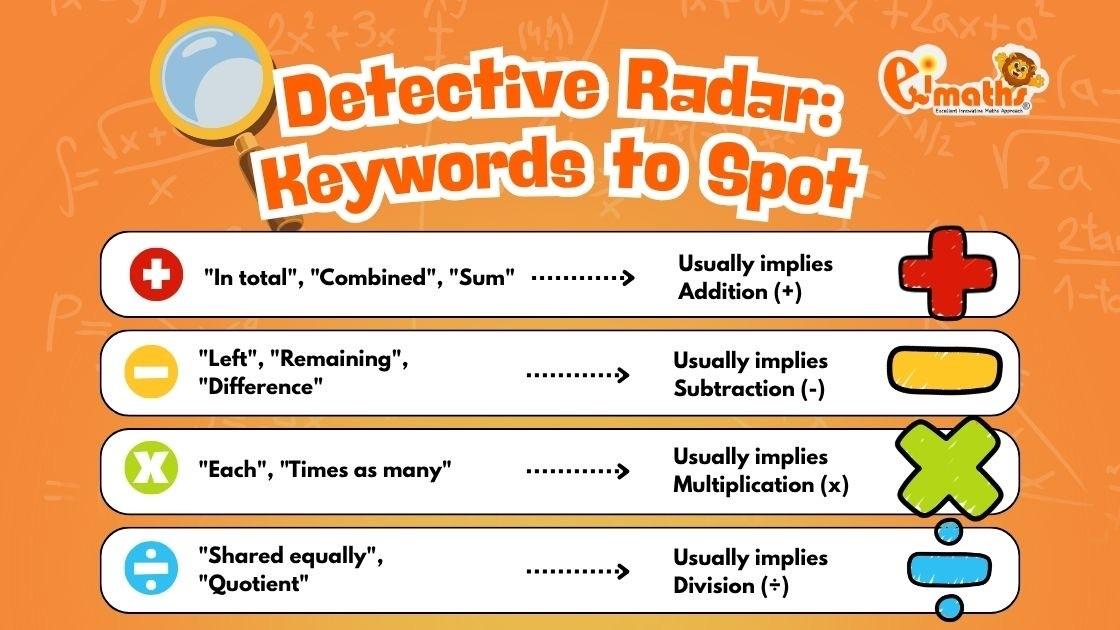
2. Teach the “Detective Strategy” (Keyword Highlighting)
When children look at a long, intimidating math question, they often experience panic. Teach your child to approach word problems like a detective hunting for clues. Give them a highlighter and instruct them to isolate key phrases that reveal operational steps.
3. Emphasize the “Why” Over the “How”
When your child finishes their homework and gets an answer right, the learning process shouldn’t stop there. Ask them: “Can you explain to me how you got that answer?” Getting a child to voice their mathematical thought process forces them to reflect on their internal logic. If they can explain the underlying concept clearly, it proves they have genuinely mastered it, rather than just getting lucky by guessing the right operation. This reflective habit is essential when discovering how to improve math problem solving skills.
4. Break Giant Problems into Bite-Sized Steps
When faced with a complex heuristic question, children often try to calculate the final answer in one single step. This leads to immediate confusion.
Train your child to treat math problems like a staircase—you can only climb one step at a time. Have them solve the very first sentence, write down that specific calculation, and completely ignore the rest of the problem until that mini-step is fully resolved.
5. Normalize and Embrace “Strategic Mistakes”
If a child is terrified of making a mistake, their brain freezes up, killing their critical thinking abilities. Change the narrative around errors in your home. When your child gets a calculation wrong, do not erase it instantly. Say: “This is an awesome mistake! Let’s trace it back together like a puzzle and see where the logic took a detour.” Analyzing wrong paths builds deep cognitive resilience.
6. Encourage Diverse Solving Pathways
There is rarely only one correct path to a solution in mathematics. If your child gets stuck using one method, encourage them to pivot. Ask them: “If we can’t solve this with an equation, can we guess-and-check? Can we look for a repeating pattern? Can we draw a table?” Showing them that math is flexible prevents them from getting trapped in rigid thinking patterns.
7. Invest in a Discovery-Based Enrichment Curriculum
Understanding how to improve math problem solving skills over the long term requires structured guidance. Traditional tuition often relies on boring test-paper drilling, which causes academic burnout. True learning requires creative stimulation.
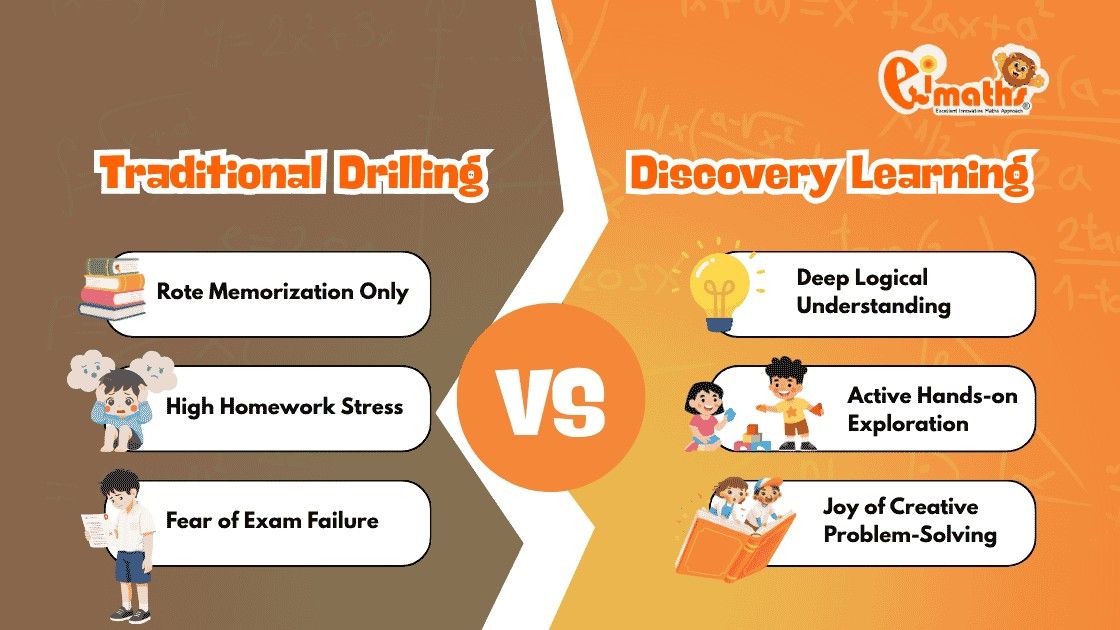
This is exactly where the eiMaths curriculum shines. We completely reject passive memorization. Our specialized program utilizes a Spiral Curriculum combined with hands-on activity boxes that allow children to physically touch, build, and explore mathematical concepts. We nurture the natural curiosity within every child, teaching them to look at math not as a chore, but as an exciting puzzle waiting to be unlocked.